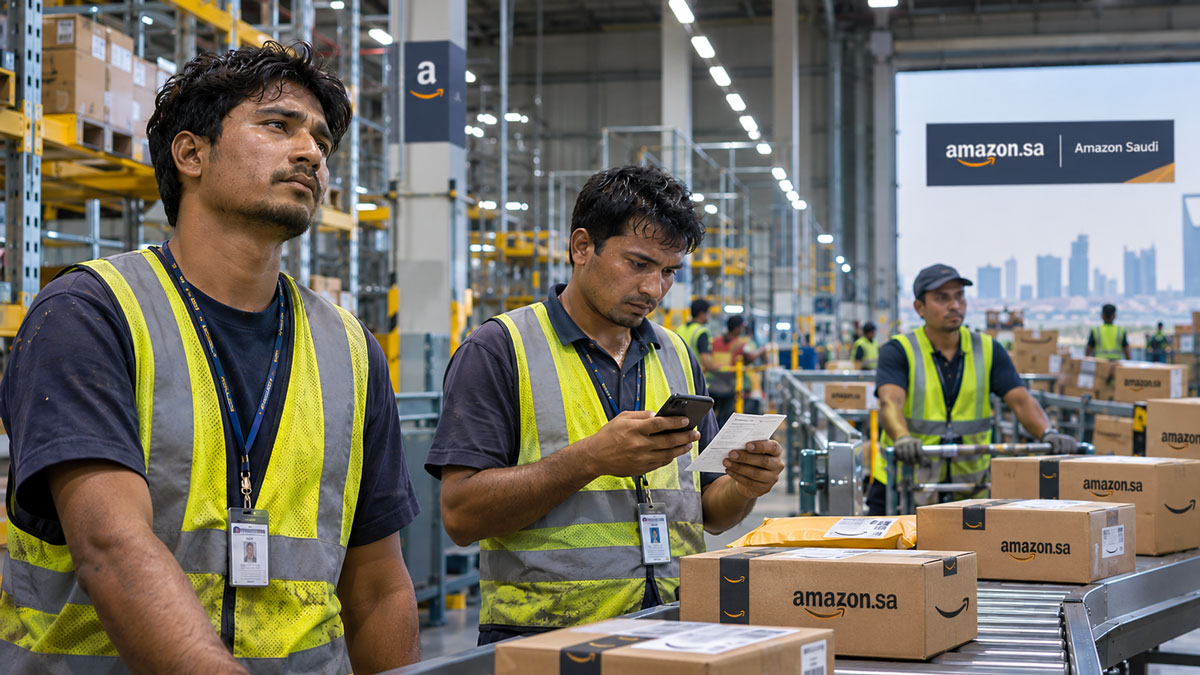
An AI-generated illustration representing Nepali migrant workers at an Amazon warehouse in Saudi Arabia. Amnesty International’s November 2026 report reveals continued concerns over job insecurity, periods without pay and difficult working conditions among migrant workers employed through third-party labour suppliers.
Nepali Workers at Amazon Warehouses in Saudi Arabia Still Face Exploitation, Amnesty Reports
Nepali migrant workers employed at Amazon warehouses in Saudi Arabia continue to face job insecurity, unpaid periods and difficult working conditions, despite efforts by the global e-commerce company to improve labour practices. A new Amnesty International report reveals that some workers have been left without jobs or salaries for months, while others struggle to change employers or return home.
The findings were published on November 16, 2026, in a report titled *Amazon in Saudi Arabia: Why Migrant Workers Remain at Risk of Exploitation*.
The report follows an earlier investigation in 2023 that exposed serious abuses involving Nepali workers recruited through third-party labour supply companies.
For its latest investigation, Amnesty International conducted research between September 2025 and March 2026. Researchers interviewed 24 Nepali and Indian migrant workers who were working or had recently worked at an Amazon warehouse in Riyadh.
The workers were employed by three separate labour supply companies responsible for arranging their employment and sponsoring their visas.
According to Amnesty, the findings show that improvements in recruitment practices and accommodation have not resolved the deeper problems faced by migrant workers.
Promised Amazon Jobs, But Employed by Other Companies
Many workers interviewed by Amnesty said they had travelled to Saudi Arabia expecting to work directly for Amazon under two-year employment contracts.
However, some discovered shortly before leaving their home countries that they would actually be employed by third-party labour suppliers rather than Amazon itself.
Several workers said they would not have accepted the offers if the employment arrangements had been clearly explained from the beginning.
This distinction has serious consequences for workers.
Although they perform duties inside Amazon warehouses, their employment contracts and immigration sponsorship remain with outside companies.
When Amazon no longer requires their services, their warehouse assignments can end while their contractual relationship with the labour supplier continues.
Almost all the workers interviewed said they could lose their Amazon assignments at any time.
A Nepali worker identified as Prakash described the uncertainty surrounding his employment.
“It’s unclear when they will kick us out from work, today or tomorrow. We’re temporary workers!” he told Amnesty International.
The uncertainty leaves workers worried about losing their income, even while continuing to work at the warehouse.
Workers Left Without Salaries for Weeks or Months
One of the most troubling findings concerns what happens after a worker’s assignment at Amazon ends.
Amnesty reported that some labour supply companies failed to provide alternative employment immediately, leaving workers without jobs and with little or no salary for weeks or even months.
During these periods, workers remained tied to the companies sponsoring their visas.
Some could not easily move to another employer or arrange their return home.
Several workers described borrowing money or depending on friends and colleagues to meet basic living expenses.
An Indian worker identified as Ayaan said he faced three difficult months after losing his Amazon assignment, during which his employer stopped paying him while he waited to return home.
He described having insufficient money and relying on colleagues for food.
Other workers reported being pressured to accept lower-paid jobs rather than receiving assistance to return to their countries.
In another case documented by Amnesty, a worker identified as Ravi said his warehouse assignment ended after he took approved leave following the death of a close relative.
He alleged that his labour supplier refused to arrange his exit unless he paid an amount equal to two months of salary.
Such experiences highlight how workers can become financially vulnerable after losing their warehouse placements.
Saudi Arabia’s Sponsorship System Remains a Concern
Amnesty International linked many of these problems to Saudi Arabia’s kafala sponsorship system, under which migrant workers have historically depended on employers or sponsors for their legal status and employment arrangements.
Although Saudi Arabia has introduced labour reforms, Amnesty said workers employed through labour supply companies continue to face significant restrictions in practice.
For Nepali workers, the consequences can be particularly difficult.
Many leave their families behind in Nepal with the expectation of earning a steady income abroad. When their employment suddenly ends, they may lose the money they depend on for everyday expenses and financial commitments back home.
The report suggests that the combination of outsourced employment and employer-linked immigration sponsorship makes it harder for vulnerable workers to leave difficult situations.
Heavy Workloads and Fear of Losing Jobs
The investigation also documented complaints about working conditions inside Amazon warehouses.
Workers described demanding productivity targets, continuous performance monitoring and pressure from supervisors to complete assigned tasks.
Some reported being warned that they could lose their positions if they failed to meet expected targets.
One worker, identified as Deepak, described being threatened with termination when he struggled to achieve performance requirements.
Amnesty said workers also faced challenges in reporting workplace problems.
Although Amazon provides a grievance reporting system called MyVoice, some interviewees said they were reluctant to raise complaints because they feared retaliation from their labour suppliers.
Others reported losing access to the system after their Amazon assignments ended, making it more difficult to report problems that occurred later.
The organisation said these conditions created an atmosphere of uncertainty among workers who feared losing their income.
Amazon Has Made Improvements Since 2023
The latest report also acknowledges significant steps taken by Amazon following Amnesty International’s earlier investigation.
After the 2023 findings, Amazon reimbursed more than US$2.45 million to 1,180 workers in Saudi Arabia for recruitment-related costs.
The company also introduced measures aimed at reducing recruitment abuses, improving accommodation standards and strengthening complaint mechanisms.
Amnesty recognised these developments as important improvements.
However, the organisation concluded that the changes had not fully addressed the risks associated with Amazon’s continued dependence on third-party labour suppliers.
In its response to the latest investigation, Amazon said it had strengthened oversight of its labour suppliers through audits and grievance procedures.
The company said its suppliers are required to pay outstanding wages and other entitlements when workers’ Amazon placements end.
It also said suppliers must explore alternative employment opportunities, help workers transfer to other employers and cover the cost of returning workers home when other suitable options are unavailable.
Amazon acknowledged that Saudi Arabia’s exit and re-entry arrangements can create risks for migrant workers but said those rules are determined by the government.
The company also highlighted its workplace safety measures, worker education programmes and policies against retaliation.
Amnesty Calls for Direct Employment
Despite the improvements, Amnesty International believes stronger action is necessary to protect migrant workers.
The organisation has called on Amazon to reduce its reliance on third-party labour supply companies and employ workers directly.
It also wants stronger protections for workers whose assignments end, including continued payment or prompt transfers to suitable alternative jobs.
Marta Schaaf, Amnesty International’s Programme Director for Climate, Economic Social Justice and Corporate Accountability, said workers continue to face uncertainty because of the way their employment is arranged.
She stressed that Amazon has the ability to improve conditions for workers employed through its suppliers but must address the underlying employment model.
Amnesty also urged Saudi Arabian authorities to fully dismantle the kafala sponsorship system and remove restrictions that allow employers to control migrant workers’ employment and freedom of movement.
The organisation said it had shared its findings with both Amazon and the Saudi government. Amazon provided responses, while the Saudi authorities had not responded by the time the report was published.
A Continuing Concern for Nepali Migrant Workers
The new investigation comes three years after Amnesty International first documented serious exploitation of Nepali workers contracted to Amazon facilities in Saudi Arabia.
That earlier report detailed allegations involving misleading recruitment practices, unlawful fees, withheld wages and restrictions on workers’ ability to leave employers.
Although some conditions have improved since then, the latest findings suggest that migrant workers remain vulnerable when their jobs depend on temporary warehouse assignments controlled by one company and employment contracts managed by another.
For Nepali families who depend on income earned abroad, the risk extends far beyond the warehouse.
A worker who loses a job may also lose the ability to send money home, repay loans or support family members.
Amnesty’s latest report raises a continuing question about the protection of migrant workers employed by major international companies through local contractors.
While compensation and improved facilities have helped address some earlier abuses, the organisation maintains that lasting protection requires greater job security, fair treatment and the freedom for workers to change employment or return home without unnecessary restrictions.