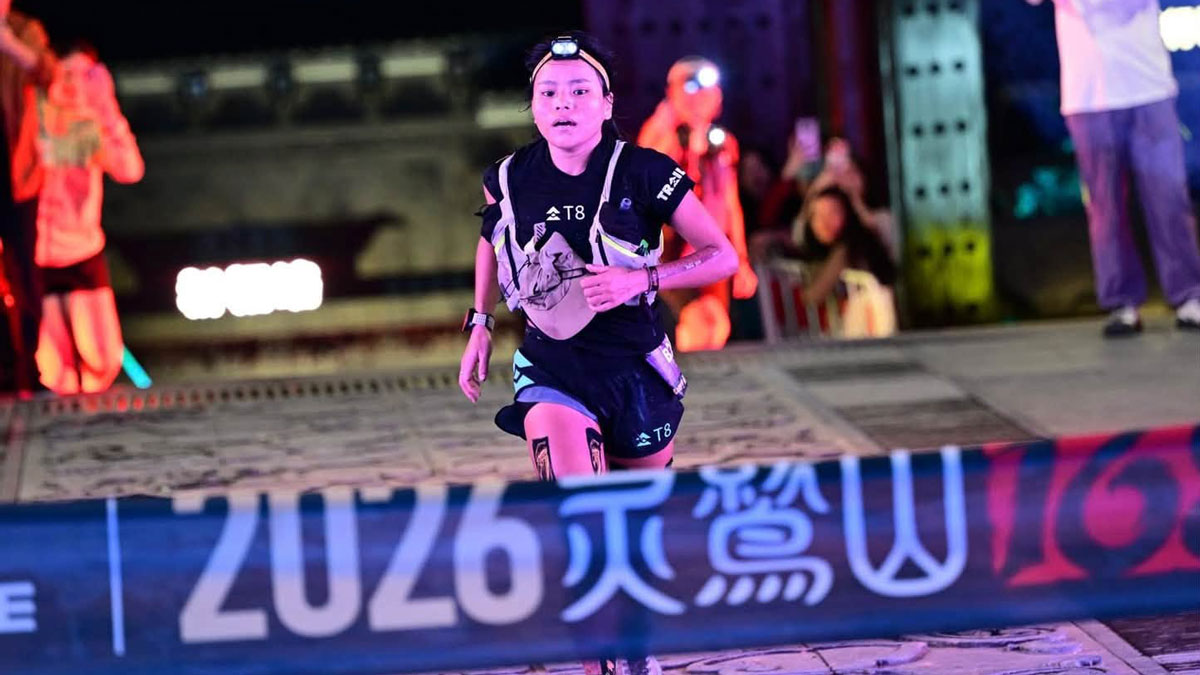
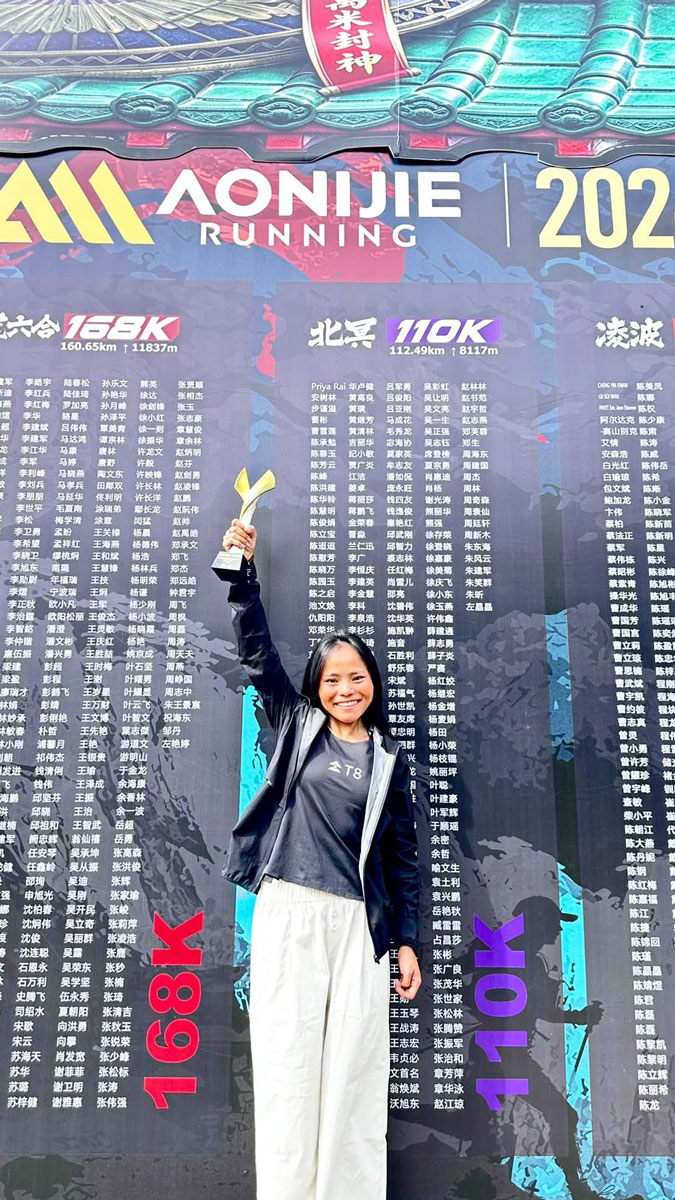
Nepali trail runner Priya Rai approaches the finish banner at China’s Lingjiu Mountain ultramarathon, where she won the women’s 110K title in what she described as the hardest race of her life.
Before Priya Rai had a place on international podiums, she had to find ways to keep running with what she could afford. At one college race, that meant competing barefoot. Later, it meant repairing worn-out running shoes rather than replacing them.
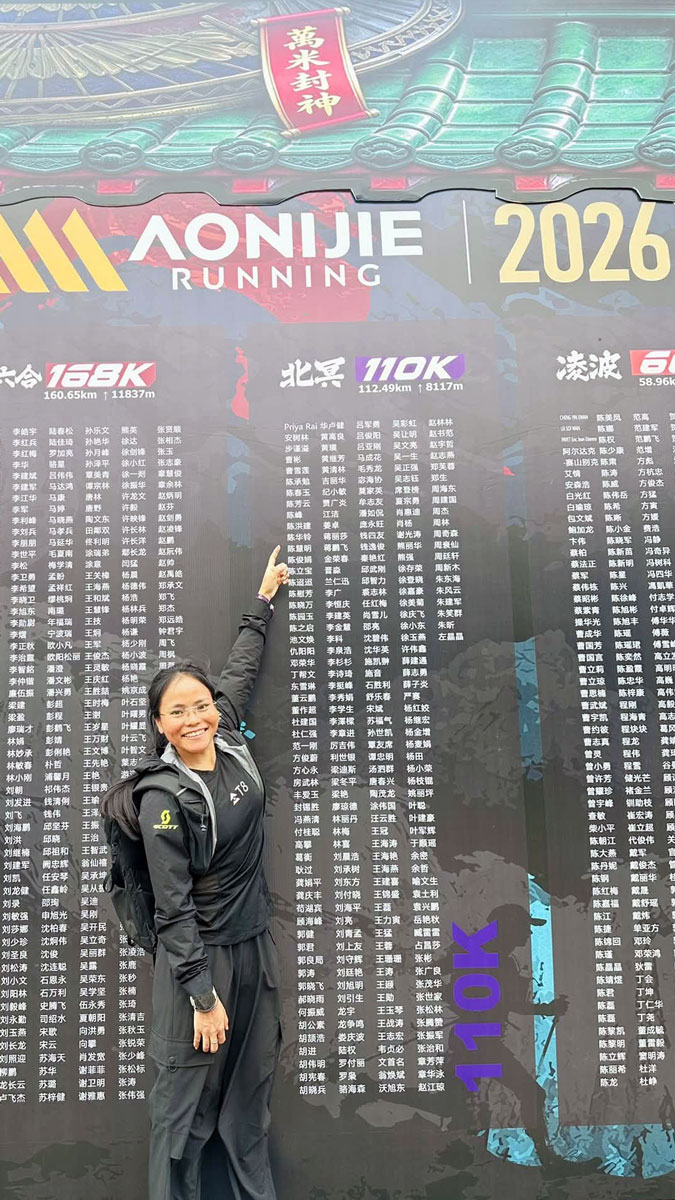
Today, the Nepali athlete is winning races across Asia. Her latest success came in China, where she claimed the women’s title in the 110K category of the Lingjiu Mountain Ancient Trail race.
Held from October 23 to 25, 2026, in Quzhou, Zhejiang province, the event added another victory to a career shaped by persistence, training and support at important moments.
For the runner from Ainselukharka in Khotang, the distance between those early races and the international circuit has taken years to cover.
A demanding win in China
Priya won the women’s 110K category at an event that attracted 4,878 participants across six race categories. China’s Mountaineering Administrative Centre confirmed her victory in its report on the competition.
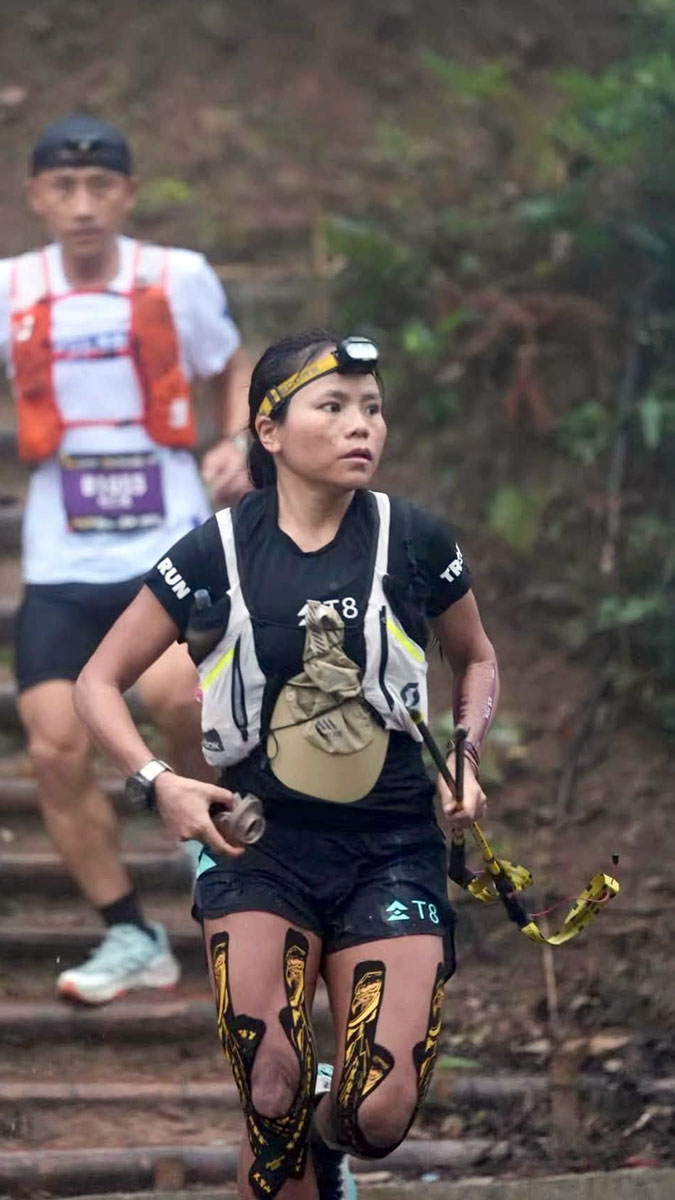
The organiser’s published course information listed the 110K route at 108.17 kilometres, with 8,284 metres of cumulative climbing and a 34-hour finishing limit. The climbing figure represents the total uphill sections along the route, rather than the height of a single mountain.
The organiser had announced a first prize of 30,000 Chinese yuan for the women’s category.
Long mountain races test much more than speed. Runners must manage their effort, food and hydration through repeated climbs and descents. Priya’s win followed another successful step into the 100K category earlier in the year, showing her growing strength over longer distances.
Finding her sport
Priya’s sporting interests developed well before trail running became her career.
She grew up in Khotang and studied in Diktel with support from her elder sister before moving to Kathmandu in 2014. In the capital, she trained in taekwondo and later played rugby, reaching Nepal’s under-19 national team.
A problem with her leg and financial difficulties interrupted her taekwondo training. Running eventually offered another direction.
Mira Rai’s achievements helped her see what a Nepali woman could accomplish on mountain trails. After making contact with Mira, Priya entered the Bhojpur Trail Race in 2018.
Her early results were mixed. Some races exposed how much she still needed to learn about pacing, preparation and endurance. By 2019, however, she had won the women’s 36-kilometre race in Bhojpur and earned a place in the Mira Rai Initiative’s Exchange and Empower programme.
That opportunity connected her ambition with training and a community that could help her develop.
When running shoes were difficult to afford
In an earlier interview, Priya recalled joining a college race without suitable kit. A teacher lent her a jersey and shorts, but she ran without shoes, finishing second overall and first among the women.
As she pursued the sport, equipment remained expensive. She described sewing damaged shoes so she could continue using them.
Support from people in Nepal’s trail-running community, including Richard Bull, helped her obtain better equipment. Those practical contributions mattered: enthusiasm could get her to a start line, but suitable shoes and structured preparation helped her compete.
Her progress also depended on learning from each race. Training on the hills around Kathmandu gradually built the strength and confidence needed for more demanding courses.
Two Asia Trail Master titles From Nepal’s trails to an overseas breakthrough
Domestic races gave Priya a foundation before she competed abroad. In 2019, she won the women’s Gosaikunda-to-Helambu marathon silver, finishing the mountain course in 7 hours, 25 minutes and 28 seconds.
Her first race outside Nepal came in December 2022 at Doi Inthanon Thailand by UTMB in Chiang Mai. She finished second in the women’s 54-kilometre race.
That result opened a new stage of her career. She had shown that she could compete internationally, and her race calendar began extending beyond Nepal.
Her domestic performances remained important. In April 2024, she won the women’s Jumla Rara Ultra shortly after winning the Manjushree Trail 50K. At Jumla Rara, she overtook the leading woman on the closing descent to finish in approximately six hours and seven minutes.
It was a useful demonstration of race judgement as well as fitness: the result was decided in the final kilometres.
In September 2024, Priya won the 85-kilometre Asia Trail Master Championship Final in Malaysia.
She claimed her second championship title at The 9 Dragons in Hong Kong on February 28, 2026. Completing the 71.4-kilometre race in 9 hours, 56 minutes and 58 seconds, she became the first woman to win the championship final twice.
The Hong Kong race was the delayed Season 10 final, following the cancellation of the planned event in Vietnam. Her second title therefore came in February 2026, even though it belonged to the preceding championship season.
Her winning margin was substantial. Hong Kong’s Cheung Man Yee finished second in 10 hours, 16 minutes and 20 seconds, more than 19 minutes behind.
Priya’s achievement remains a milestone in the series. The next season concluded in October 2026, when fellow Nepali runner Sunsari Rokaya became the new women’s champion.
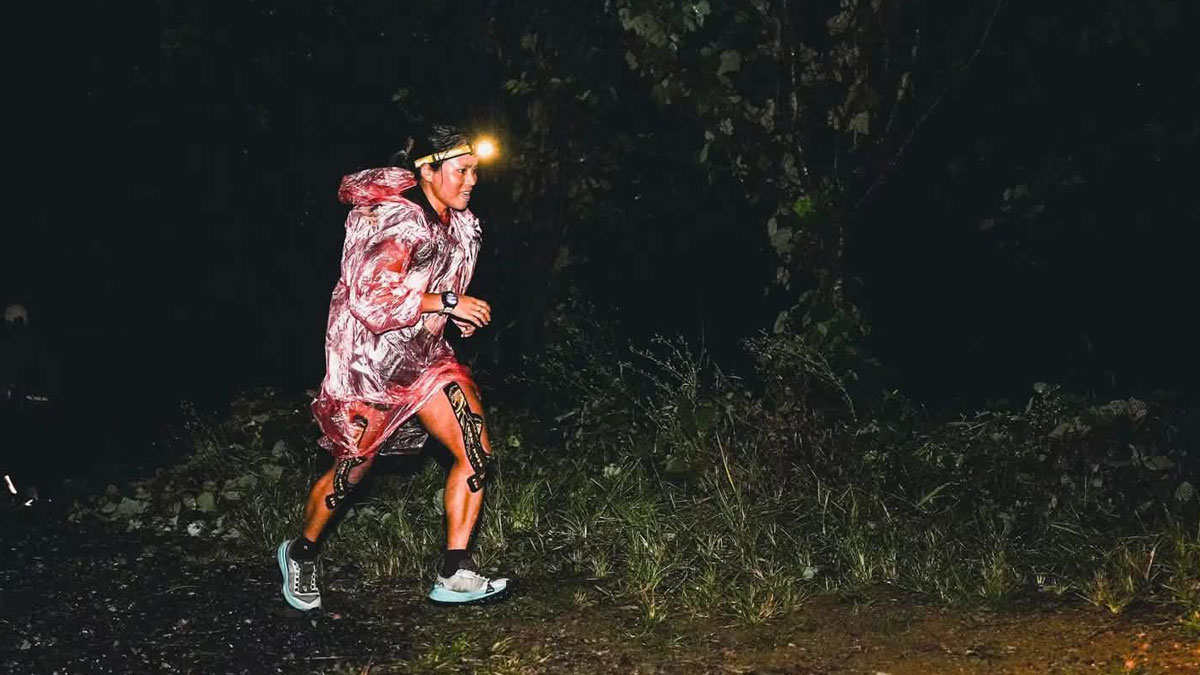
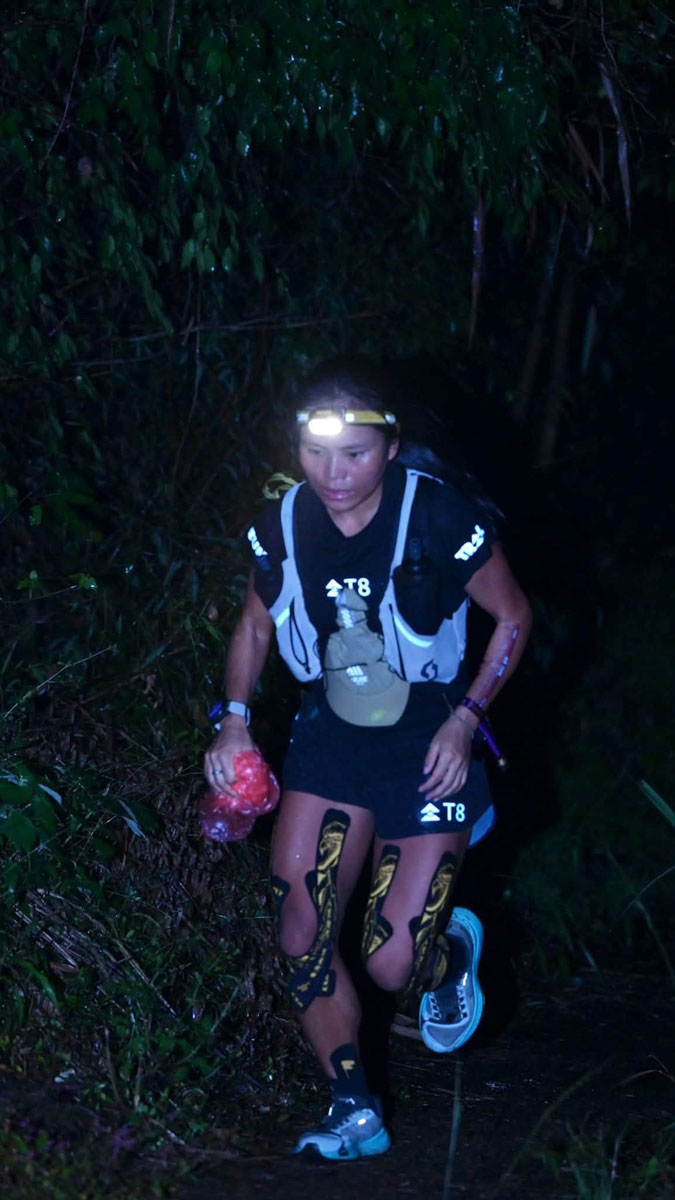
Priya Rai runs through the night during China’s Lingjiu Mountain ultramarathon, wearing a headlamp and rain poncho. The Nepali athlete won the women’s 110K title, later describing the event as the hardest race she had ever completed.
Going longer at Lake Toba
Another important result came in Indonesia on June 13, 2026.
Priya won the women’s Caldera Crown 100K at Lake Toba by UTMB, covering the recorded 101.1-kilometre course in 13 hours, 17 minutes and 18 seconds. She finished third overall.
The route included 4,205 metres of climbing. Her result showed that she could carry her competitive strength into a longer race category.
Earlier in February, she had also won the women’s Kalaw Trail Run in Myanmar. UTMB’s results record lists her time as 5 hours, 38 minutes and 39 seconds over 50.3 kilometres, again placing her third overall.
These results give the China victory a wider context. It is part of a series of strong performances across different courses and distances.
Support that helps talent grow
Priya’s circumstances have changed since the days when replacing running shoes was a struggle. Running apparel brand T8 now lists her among its supported athletes.
Her story also extends beyond results. She has pursued her studies alongside sport and spoken about the need for better recognition and support for trail running in Nepal.
The sport offers opportunities for Nepali athletes, but reaching an overseas start line requires resources: coaching, equipment, travel arrangements and sustained financial backing.
Priya’s journey shows what can happen when ability and commitment meet those opportunities. The barefoot college race belongs to her past. The athlete winning in China has been built through years of practice, competition and learning—and through people who helped her keep going.