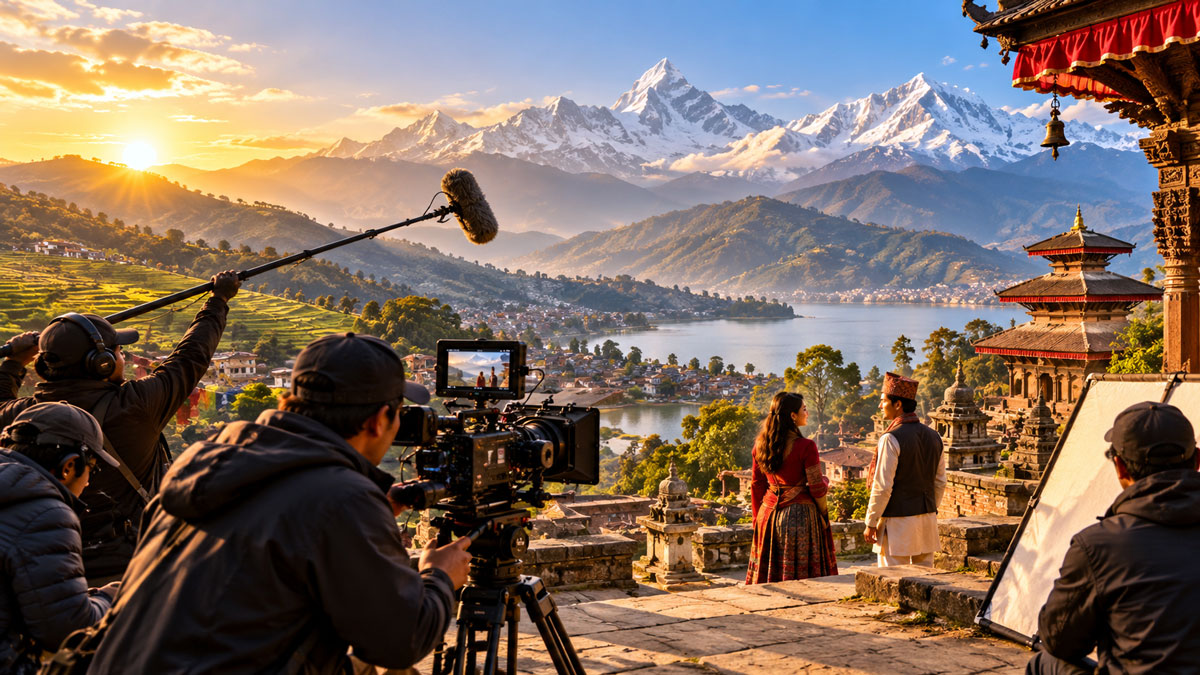
A representative illustration of filmmakers working amid Nepal’s natural beauty and cultural heritage. The government’s original film grant proposal aimed to support similar culturally significant storytelling projects.
Nepal Announced Rs 9.5 Million for Filmmakers. Now the Grant Notice Is Cancelled
Nepal’s government has cancelled its recently announced application notice for film production grants, just days after unveiling financial support of up to NPR 9.5 million (Rs 95 lakh) per film. The initiative was designed to encourage original Nepali cinema exploring the country’s culture, history, traditions and national identity.
The Ministry of Information and Communication published the cancellation notice on October 30, 2026 (Kartik 13, 2083). The original announcement, issued on October 27, had invited filmmakers, writers and production companies to apply for financial assistance in three categories: scriptwriting, production and post-production.
The ministry’s latest public notice confirms the cancellation of the earlier announcement. However, it remains unclear whether the government intends to revise the application process, issue a fresh notice or make changes to the wider funding programme.
The original initiative was introduced under the government’s approved annual programme for fiscal year 2083/84, with NPR 35 million (Rs 3.5 crore) allocated to encourage films of cultural and national significance.
How Much Funding Was Originally Offered?
Under the announced guidelines, filmmakers could seek financial support at different stages of production.
The proposed grant structure included:
Scriptwriting: Up to NPR 500,000 (Rs 5 lakh) per screenplay, covering a maximum of five projects.
Film Production: Up to NPR 7 million (Rs 70 lakh) per film, covering a maximum of three projects.
Post-Production: Up to NPR 2 million (Rs 20 lakh) per film, covering a maximum of five projects.
A film qualifying independently for all three categories could theoretically receive a combined maximum of NPR 9.5 million (Rs 95 lakh), subject to the selection process and applicable conditions.
Although the government had allocated NPR 35 million to the initiative, the maximum awards across the specified number of projects totalled NPR 33.5 million.
The grants were intended to support independent filmmakers and production companies working on culturally meaningful stories that might otherwise struggle to secure adequate financing.
What Types of Films Were Eligible?
The original programme placed particular emphasis on original stories highlighting Nepal’s cultural heritage, national identity and social values.
Films exploring the country’s history, traditional lifestyles, festivals, local communities, geographical diversity and tourism were among the types of projects the government intended to support.
Stories promoting national unity, sovereignty, social harmony and cultural understanding were also included in the eligibility criteria.
Applicants were expected to present distinctive, creative and original screenplays rather than copied or previously produced stories.
The guidelines also required scripts to be registered with Nepal’s Copyright Registrar’s Office before submission.
By encouraging films rooted in local experiences and cultural traditions, the initiative aimed to support storytelling that could introduce audiences to lesser-known communities, locations and aspects of Nepali life.
No AI Use and Strict Technical Requirements
The original guidelines also introduced technical and production requirements for grant-supported films.
Projects were required to be filmed using cameras capable of recording in 4K resolution, while the completed film could not exceed 90 minutes.
One notable condition prohibited the use of artificial intelligence (AI) in film production.
The guidelines also restricted filmmakers from using grant money to purchase equipment or other materials outside the approved production expenses.
These conditions formed part of the original grant framework. Their continued application will depend on whether the government retains or revises the programme following the cancellation notice.
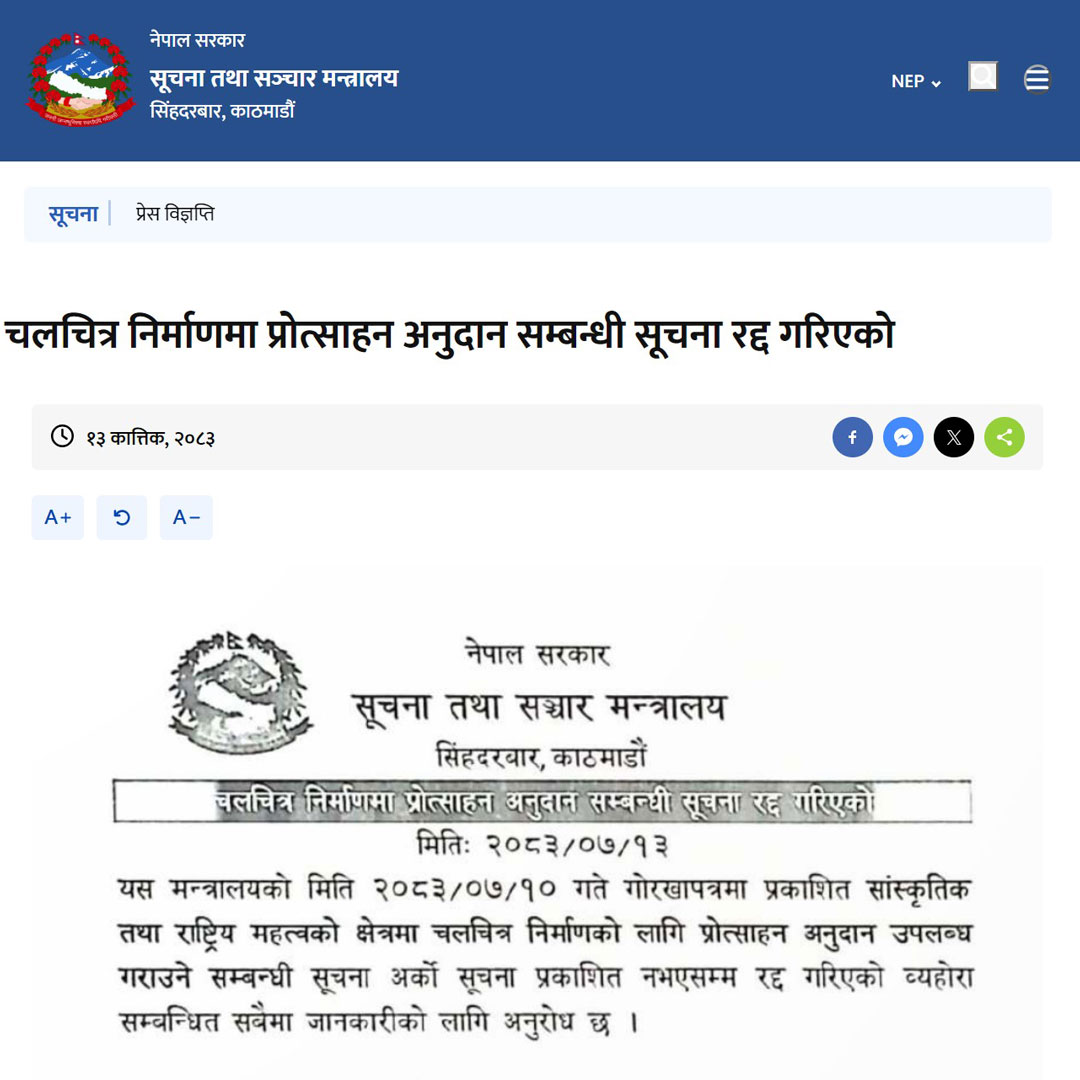
Nepal’s Ministry of Information and Communication officially cancels its earlier film production grant application notice on October 30, 2026 (Kartik 13, 2083). The original announcement offered up to NPR 9.5 million per film.
Filmmakers Questioned the 21-Day Application Deadline
Before the announcement was cancelled, the programme had already drawn criticism from members of Nepal’s film industry.
The ministry initially gave interested filmmakers just 21 days to submit applications.
Actress and filmmaker Nisha Adhikari raised concerns about the short application window, arguing that developing a meaningful film project requires adequate preparation.
Film producer and distributor Pradeep Kumar Udaya also questioned why the programme was being administered through the ministry instead of the Film Development Board.
Other filmmakers expressed concerns that the limited application period could disadvantage newcomers who had not already developed their scripts and project documents.
Ministry officials had previously indicated that the deadline could be extended if there were insufficient applications and that the process could be revised in response to feedback.
However, the government has not publicly established a direct connection between those concerns and the subsequent cancellation of the notice.
What Documents Did Applicants Need?
Under the original announcement, applicants were required to submit details of their proposed films, including the title, story, screenplay, language, production team and estimated budget.
The required documents included a copy of the applicant’s Nepali citizenship certificate, a complete screenplay with dialogue, a digital script copy and proof of copyright registration.
Applicants seeking production or post-production grants were also expected to provide relevant filming permission from the Film Development Board, a detailed production plan and a proposed budget.
The selection process was to be overseen by a committee coordinated by a joint secretary at the ministry.
According to the original framework, successful applicants would receive an initial 20 percent of the approved grant following the required agreement and procedures. The remaining amount would be released in instalments based on project progress, compliance with the agreed conditions and recommendations from the Film Development Board.
What Happens Next?
The cancellation has created uncertainty for filmmakers who were preparing to apply for the government support.
While the original announcement outlined substantial financial assistance for culturally significant films, the ministry has not yet clarified whether applications will reopen under a revised timeline or procedure.
For now, filmmakers should check the ministry’s official announcements before submitting applications under the cancelled notice.
The wider idea behind the initiative remains significant for Nepal’s film industry. Financial support for films exploring local culture, history and everyday life could encourage filmmakers to bring stories from different parts of Nepal to the screen.
Whether that opportunity moves forward will depend on the government’s next announcement and the final arrangements for implementing the funding programme.